

Imagine snorkeling when a Galapagos penguin suddenly jumps from the rocks and swims right past you. Later, on a hike, you see blue-footed boobies nesting just a few feet from the trail. By afternoon, curious sea lions swim around you.
These encounters make the Galapagos unlike almost any other wildlife destination. The islands sit about 600 miles off the coast of Ecuador. Their isolation created an extraordinary ecosystem, including many species found nowhere else.

- How Should You Visit the Galapagos?
- Getting to the Galapagos
- Our First Night on Santa Cruz Island
- Boarding Celebrity Flora
- Our First Expedition: Santiago and Rabida
- Exploring Isabela Island
- Lava Landscapes and Penguins
- From Sea Turtles to Nesting Boobies
- Sea Lions and Boobies on San Cristobal
- Giant Tortoises and Rewilding
- The Galapagos, Ten Years Later
- Why We Returned to the Galapagos
Wildlife Up Close
However, simply seeing these animals isn’t what makes a trip here so memorable. It is how close you can get to them. Marine iguanas sun themselves beside trails, while giant tortoises roam through the highlands. Penguins dart through the water, and sea lions are equally comfortable on beaches and town sidewalks.
Even the birds seem surprisingly unconcerned by their human visitors. Blue-footed boobies nest beside trails, while frigatebirds raise their chicks nearby. In the Galapagos, you don’t simply search for wildlife. You are often surrounded by it.

Returning Ten Years Later
We first visited the Galapagos ten years ago aboard a small catamaran yacht. This time, we wanted a more upscale experience and chose a one-week expedition cruise aboard Celebrity Flora.
Over six expedition days, we hiked volcanic landscapes, explored coastlines, and snorkeled with remarkable marine life. Yet our second visit also revealed some unexpected differences from the Galapagos we remembered.

This article shares what it was like to return after ten years. We also explain how we got there and why we chose Celebrity Flora. Most importantly, we’ll share the experiences that made the Galapagos worth visiting all over again.
How Should You Visit the Galapagos?
One of the first decisions when planning a Galapagos trip is how you want to explore the islands. You can stay on land or travel between islands aboard a ship. We chose the second option on both visits, although on very different vessels.
Staying on Land
A land-based trip allows you to stay in places such as Santa Cruz or San Cristobal. You can experience local communities while enjoying access to hotels, restaurants, and shops.
However, reaching more remote locations usually requires booking day trips with local boat operators. Excursions can sometimes be canceled if operators don’t have enough passengers. For us, traveling by ship removes much of that uncertainty and makes exploring multiple islands easier.
Small Yacht or Expedition Ship?
On our first visit ten years ago, we traveled aboard a small 16-passenger yacht. We loved the intimate experience and waking up near a different destination each morning. However, accommodations and amenities were naturally limited.

This time, we wanted the same expedition experience with more comfort. We chose Celebrity Flora, a ship designed specifically for exploring the Galapagos. It carries a maximum of only 100 passengers while offering spacious accommodations, excellent dining, and upscale service.

Most importantly, the added comfort didn’t replace the adventure. Our days still revolved around hiking, snorkeling, and wildlife viewing. The difference was returning to a beautiful ship at the end of each expedition.
Getting to the Galapagos
Flights to the Galapagos depart from mainland Ecuador, primarily from Quito and Guayaquil. We flew to Baltra, where Celebrity passengers meet the cruise team before boarding Flora.
Celebrity offers extended packages that include the flight to Baltra and arrangements before the cruise. We booked only the cruise, so getting to Baltra on time was our responsibility. Rather than risk flying on embarkation day, we arrived one day early.

Why We Arrived Early
That decision proved especially important when one of our friends was bumped from our original flight. Fortunately, he caught a later flight that day and still joined us in Santa Cruz. Had we traveled on embarkation day, he could have missed the ship. If you arrange your own flights, we strongly recommend arriving in the Galapagos at least one day early.
Before You Fly
Travelers must obtain a Transit Control Card, or TCT, before flying to the Galapagos. The card currently costs $20 per person and should be completed online before your flight. At the airport, you must have it validated at the CGREG counter before checking in.
Your luggage also undergoes a special X-ray inspection before airline check-in. Officials then secure checked bags with a zip tie, preventing you from reopening them. The inspection helps protect the Galapagos from invasive species and other biological threats.
The Galapagos National Park Fee
International adult visitors currently pay a $200 Galapagos National Park entrance fee upon arrival. Children under 12 pay $100. Payment must be done in cash, using U.S. dollars, upon arrival at the Baltra Airport. Celebrity then reimbursed our $200 entrance fee in cash after we boarded Flora. Travelers should confirm current fees, payment requirements, and cruise policies before leaving home.

The additional procedures sound complicated, but we found them relatively straightforward. Knowing what to expect makes the process considerably easier.
Our First Night on Santa Cruz Island
Arriving early also gave us an extra afternoon to experience the Galapagos. We stayed at the historic Angermeyer Waterfront Inn in Puerto Ayora, a charming boutique hotel directly on the water. We really enjoyed our stay there although it was further than we expected from the airport.
Getting There Was Part of the Adventure
Reaching the hotel from Baltra Airport required a bus, ferry, another bus, and finally a water taxi. The hotel arranged everything for $100 per person round trip. This included our return to Baltra Airport the following morning to meet the Celebrity team.


Instead of feeling like a complicated transfer, the journey became our introduction to the unusual geography of the Galapagos.
Our First Wildlife Encounters
The Angermeyer has a beautiful waterfront setting and a nice restaurant on the property. However, we didn’t spend the entire afternoon at the hotel.


We walked to a nearby beach and began spotting birds and lizards along the way. Then a sea lion appeared while we were relaxing on the beach. We hadn’t even boarded the Flora, yet the Galapagos was already introducing itself. What began as an extra night to protect against flight delays became the perfect start to our trip.


Boarding Celebrity Flora
The next morning, we returned to Baltra Airport and met the Celebrity land team. From there, Celebrity handled our transfer to Flora, and we boarded around 1:00 p.m.
Our first afternoon included a delicious lunch, the required safety drill, and distribution of our snorkeling equipment. We also attended an orientation covering the ship and the expedition program. After dinner, we were ready for our first expedition the following morning.


Expedition Travel Without Roughing It
Celebrity Flora was designed specifically for the Galapagos and carries a maximum of only 100 passengers. The beautiful all-suite ship felt intimate while offering considerably more comfort than the small yacht from our first visit.
The crew and service were exceptional, and the food was consistently excellent and varied. After several hours of hiking or snorkeling, returning to Flora for lunch and some downtime became a welcome part of our routine.


Most days included morning and afternoon expeditions. Depending on the location, we could choose among longer hikes, shorter walks, tender rides, and snorkeling. We generally selected the more active options.
A Marina Designed for Expeditions
One of Flora’s smartest features was its embarkation marina on Deck 3. This is where we boarded the custom-designed tenders that carried us to expedition sites.


Our wetsuits and snorkeling equipment remained at the marina between excursions. We didn’t have to carry wet gear back to our suite after every snorkel. It was a small detail that made a surprisingly big difference.
Flora provided the comfort, organization, and service we wanted on our second visit. Once we stepped into a tender, however, the focus shifted completely to exploring the Galapagos.
Our First Expedition: Santiago and Rabida
Our first full expedition day took us to Santiago and Rabida Islands. Within hours, we were hiking, snorkeling, and experiencing the remarkable variety of Galapagos wildlife.
Exploring Puerto Egas
We started at Puerto Egas on Santiago with one of the longer walking options. Along the trail, we spotted lava lizards, land iguanas, Galapagos mockingbirds, yellow warblers, and oystercatchers. Near the coastline, bright red Sally Lightfoot crabs stood out against the dark volcanic rocks. We also encountered Galapagos fur seals resting along the rocky shoreline.


After the walk, we headed into the water for our first snorkel. Colorful tropical fish surrounded us, including king angelfish and yellowtail surgeonfish. It was our first glimpse of how important snorkeling would become during the week.
Flamingos and Sea Lions on Rabida
That afternoon, we continued to Rabida, with its distinctive reddish volcanic landscape. A short walk took us past a lagoon where we spotted flamingos. We also encountered mockingbirds, lizards, and sea lions around the island.


However, our favorite experience came when we returned to the water. Three curious Galapagos sea lions began swimming around us. They twisted, turned, and darted through the water as if we had entered their playground. Instead of simply watching them, we suddenly found ourselves immersed in their underwater world.


By the time we returned to Flora, we had hiked two islands and snorkeled twice. We had seen everything from land iguanas and flamingos to fur seals and tropical fish. Most memorably, we had spent part of the afternoon swimming with three very curious sea lions. And this was only our first expedition day.
Exploring Isabela Island
Our second expedition day took us to Isabela, the largest island in the Galapagos. We began with a long tender ride through Elizabeth Bay, where the surrounding waters and rocky shoreline provided excellent wildlife viewing.
Wildlife Around Elizabeth Bay

Here we spotted sea turtles, small blacktip sharks, Galapagos penguins, and blue-footed boobies. However, the morning’s most memorable encounter involved a sea lion swimming with a freshly caught stingray in its mouth. (check it out) It was one of those completely unexpected Galapagos moments. We happened to be in the right place at exactly the right time.


Snorkeling and Hiking at Tagus Cove
Later, we headed to Tagus Cove for deep-water snorkeling. Visibility was poor that day, but we still spotted fish, sea stars, and a diamond stingray. Galapagos penguins and pelicans also appeared around the cove.

Our final adventure took us above the water. We chose the longer hike toward Darwin Lake, a saltwater lake inside a volcanic crater. The trail climbed steadily from the shoreline, with increasingly impressive views as we gained elevation. From above, we could look across the crater lake toward the Pacific Ocean beyond it.
Within a single day, Isabela gave us sea turtles, sharks, penguins, stingrays, and a spectacular volcanic landscape. Yet the image we remembered most was that sea lion proudly swimming past us with its catch.


Lava Landscapes and Penguins
Our third expedition day revealed another side of the Galapagos. We returned to Santiago Island, where the volcanic landscape at Sullivan Bay became the main attraction. Later, Bartolome provided one of our best snorkeling experiences of the trip.
Walking Across a Lava Field
Sullivan Bay is covered by vast fields of black lava created by eruptions during the late 1800s. Much of the surface consists of pahoehoe, with extraordinary smooth, folded, and rope-like formations.


We walked directly across this stark landscape, spotting lava lizards and occasional plants growing from cracks in the rock. Their presence made the otherwise barren landscape seem even more dramatic.
A tender ride along the coast brought the wildlife back into focus. We spotted Galapagos penguins, pelicans, blue-footed boobies, brown noddy terns, marine iguanas, and bright Sally Lightfoot crabs.


Snorkeling at Bartolome
That afternoon, we headed to Bartolome for deep-water snorkeling, followed by some beach time and additional snorkeling. The volcanic landscape continued underwater, where we could see unusual rock formations and what appeared to be lava tubes.
Schools of tropical fish surrounded us before we encountered something considerably larger. A white-tip reef shark appeared below us, adding some excitement to the snorkel.

Then a couple of Galapagos penguins jumped from the rocks and began swimming past our group. Watching penguins from a tender was already exciting. Seeing them dart through the water beside us was completely different. It became one of our favorite wildlife encounters of the entire trip.
Some passengers chose to climb to Bartolome’s summit for panoramic views across the islands. We chose to spend more time in the water. For us, swimming with Galapagos penguins made that an easy choice.

From Sea Turtles to Nesting Boobies
Our fourth expedition day began at Las Bachas Beach on Santa Cruz and continued at North Seymour Island. It combined another excellent snorkeling experience with some of the best bird viewing of our trip.
Las Bachas Beach
The morning started with a walk along Las Bachas Beach and its nearby lagoon. We spotted flamingos, a black-necked stilt, a small sandpiper, and Sally Lightfoot crabs. We also watched a marine iguana swimming in the water.


Afterward, we snorkeled directly from the beach. Tropical fish surrounded us before we encountered the highlight of the morning. A giant sea turtle was swimming nearby. We had already seen sea turtles from our tenders, but swimming near one was completely different. We kept our distance and watched as this enormous animal moved gracefully through the water.
North Seymour Island
That afternoon, we went deep-water snorkeling at North Seymour. We encountered white-tip reef sharks, schools of tropical fish, and an octopus before returning to land for a long, rocky walk.


North Seymour provided some of the best bird encounters of the entire cruise. We saw frigatebirds with their chicks and yellow land iguanas along the trail. Most memorable were the blue-footed boobies nesting directly on the ground.
Several boobies were sitting on eggs only a short distance from the trail. We could observe them remarkably closely without disturbing them. We also spotted distinctive swallow-tailed gulls with their bright red eye rings. Even those of us who weren’t serious birdwatchers found ourselves fascinated. In the Galapagos, the birds can be so close that binoculars sometimes seem unnecessary.


This was also one of the places where we noticed differences from our first visit ten years earlier. The breeding activity seemed less advanced than we remembered. Flora’s naturalists told us the breeding season was running unusually late this year. We would learn more about the possible reasons as the week continued.
Sea Lions and Boobies on San Cristobal
Our fifth expedition day brought us to San Cristobal. Rain caused us to skip the planned morning walk, so we spent our time exploring Puerto Baquerizo Moreno instead.
Where Sea Lions Take Over the Town


We had already encountered plenty of sea lions, but here they seemed to be part of everyday town life. They gathered along the waterfront and beaches, often remarkably close to people. Several were resting on beaches and sidewalks, and there were numerous babies. Watching these pups play and interact made it easy to spend much of the morning along the waterfront.
It was another reminder that Galapagos wildlife isn’t confined to remote islands. Sometimes the animals are right in the middle of town.
Blue Feet, Red Feet, and Wild Goats
That afternoon, we headed to the northeastern part of San Cristobal for a long walk through a rugged cliff landscape. The main attraction was the birdlife.

We saw several blue-footed boobies nesting directly on the ground. Then we began spotting red-footed boobies and their young chicks in the trees. Seeing both species during the same walk made the contrast fascinating. Blue-footed boobies nested on the rocky ground below us, while red-footed boobies occupied the vegetation above.
We also spotted wild goats roaming across the landscape. Unlike the native wildlife surrounding us, men introduced goats to the Galapagos. Considered an invasive species, goats can damage native vegetation and compete with native animals for food.

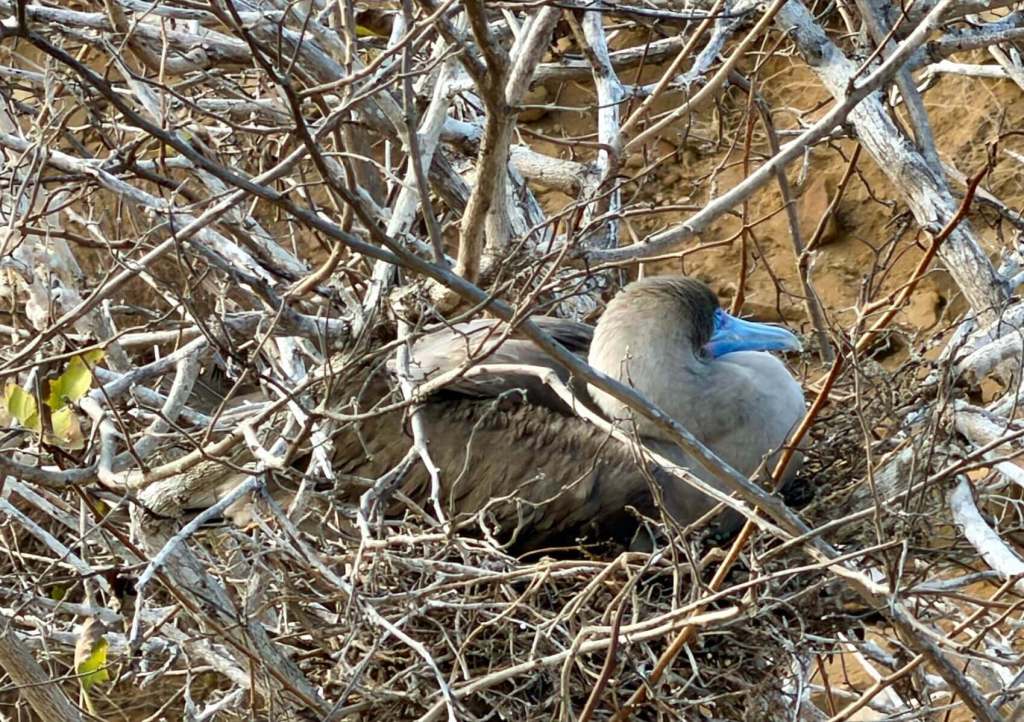


Their presence provided another reminder of how easily introduced species can disrupt the Galapagos ecosystem. Protecting these islands involves managing what doesn’t naturally belong here as well as protecting what does.
After a morning surrounded by sea lions, our afternoon combined nesting seabirds, wild goats, and dramatic coastal scenery. San Cristobal delivered two very different Galapagos experiences.
Giant Tortoises and Rewilding
Our final expedition day brought us back to Santa Cruz Island. This time, the focus shifted from simply observing wildlife to protecting the Galapagos ecosystem.
Protecting the Giant Tortoise
We began at the Fausto Llerena Giant Tortoise Breeding Center at the Charles Darwin Research Station. Here, conservation programs protect young tortoises during their most vulnerable years. Many can eventually return to suitable habitats in the wild.


The visit gave us a better understanding of the work behind the recovery of these iconic animals. The giant tortoise may symbolize the Galapagos, but its survival has required decades of conservation efforts.
Helping Rewild the Galapagos

Next, we traveled into the Santa Cruz highlands to plant native Scalesia tree saplings. The project helps restore habitat damaged by invasive species and other environmental pressures. Each of us planted a couple of small saplings. After spending the week observing the Galapagos, it felt good to make even a small contribution to its restoration.
Giant Tortoises Everywhere
We then visited Primicias Ranch, where giant tortoises roam freely through the highlands. We didn’t have to search for them. They were everywhere. Tortoises grazed among the vegetation, rested near the paths, and slowly crossed the landscape. Everywhere we looked, another seemed to appear.

Seeing so many giant tortoises living freely was completely different from visiting them at the breeding center. Here, we were walking through a landscape that clearly belonged to them.
The experience completed the story of our final expedition day. We learned how vulnerable tortoises are protected, helped restore native habitat, and then watched these extraordinary animals thriving in the wild.

It was a fitting conclusion to six remarkable days exploring the Galapagos.
The Galapagos, Ten Years Later
Returning almost ten years after our first visit gave us an unusual opportunity for comparison. We traveled during roughly the same late July and early August period both times. Yet something felt different on this trip.

We still had extraordinary wildlife encounters, but the animals sometimes seemed less abundant than we remembered. We saw fewer sea turtles in many areas and no whales during the entire week.
Two visits certainly aren’t enough to draw scientific conclusions. Wildlife moves, conditions change, and every Galapagos itinerary produces different sightings. However, the differences were noticeable.
Warmer Water and a Late Breeding Season
Flora’s naturalists told us that the bird breeding season was running about two months behind schedule. They also explained that unusually warm ocean temperatures were affecting the marine food supply.

The Galapagos depends heavily on cold, nutrient-rich water that supports the marine food chain. During El Niño, warmer water reduces those nutrients and can make food scarcer. This can affect reproduction among penguins, boobies, sea lions, and other wildlife.
Those conditions were present during our visit. The Charles Darwin Foundation reported that El Niño developed during the first half of 2026. By July, sustained ocean warming was affecting the waters surrounding the Galapagos.
A Changing Galapagos
El Niño is a natural climate cycle, so we cannot attribute the differences between our two visits directly to climate change. However, scientists are studying how rising ocean temperatures and repeated El Niño events may affect the Galapagos ecosystem over time.

Our observations weren’t scientific. They were simply the impressions of travelers returning to the same place during the same season ten years later. Still, the distinctions made us see the Galapagos differently. On our first visit, we focused almost entirely on the extraordinary wildlife. This time, we became much more aware of how dependent that wildlife is on a delicate and changing environment.
The Galapagos can seem timeless. Our second visit reminded us that it isn’t.
Why We Returned to the Galapagos
Ten years after our first visit, the Galapagos still managed to surprise us. This time, Celebrity Flora provided considerably more comfort and luxury, but the ship was never the real star. The wildlife and remarkable landscapes were the reasons we wanted to return.

Our strongest memories came from experiences we could never have planned. Three curious sea lions joined us while snorkeling at Rabida. Penguins suddenly dove into the water beside us at Bartolome. Giant tortoises seemed to be everywhere in the Santa Cruz highlands.
Our second visit also made us more aware of how fragile this environment can be. We noticed changes from our first trip and learned more about the conservation work protecting these islands. That gave us an enhanced and different appreciation for everything we encountered.

Perhaps that is what makes the Galapagos so compelling. You can return to the same islands during the same season and have a completely different experience. We came back after ten years expecting to rediscover a place we already loved. Instead, the Galapagos gave us plenty of reasons to experience it all over again.

Leave a Reply