

During our month-long stay in Lisbon, we wanted to explore more of the surrounding region. Óbidos quickly became the perfect destination for an overnight road trip. Located about 80 kilometers north of Lisbon, Óbidos is one of Portugal’s most beautiful historic towns. This small medieval town sits on a hilltop, surrounded by centuries-old fortified walls.
Inside the walls, narrow cobblestone streets wind past whitewashed houses decorated with colorful flowers. Historic churches, shops, cafés, and restaurants fill the compact town center. An imposing medieval castle rises above it all. Óbidos is also known as the “Town of the Queens.” For centuries, Portuguese kings traditionally gave the town to their queens as a wedding gift.

Many tourists visit Óbidos as a day trip from Lisbon. However, we decided to spend the night and use the town as our base. Having a rental car also allowed us to explore several fascinating destinations nearby. We visited Batalha, Alcobaça, Buddha Eden, and the seaside town of Nazaré.
This turned our visit into much more than a simple day trip to Óbidos. Over two days, we explored medieval streets, magnificent monasteries, sculpture-filled gardens, and Portugal’s dramatic Atlantic coastline. Staying overnight also gave us something most day visitors miss. After the crowds departed, we explored an almost deserted Óbidos under the romantic glow of evening streetlights.
Our two-day road trip proved an excellent way to experience Óbidos and several highlights of central Portugal. Best of all, everything was within an easy drive of Lisbon.
- A Brief History of Óbidos: The Town of the Queens
- Getting from Lisbon to Óbidos: Why We Rented a Car
- Where to Stay in Óbidos: Consider Parking and Luggage
- DAY ONE: EXPLORING ÓBIDOS AND BATALHA
- Our First Walk Through Medieval Óbidos
- A Quick Portuguese Snack Before Exploring More of Óbidos
- Porta da Vila and Walking the Medieval Walls of Óbidos
- An Afternoon Side Trip to the Monastery of Batalha
- Back to Óbidos and Checking Into Hotel Real d’Óbidos
- Dinner at O Conquistador in Óbidos
- Óbidos After Dark
- DAY TWO: BUDDHA EDEN, ALCOBAÇA AND NAZARÉ
- Final Thoughts: Óbidos Is Just the Beginning
A Brief History of Óbidos: The Town of the Queens
Óbidos has a long history that stretches back well before Portugal became an independent kingdom. Romans settled in the region, and the Visigoths later controlled the area. The Moors arrived in the eighth century and strengthened the town’s defenses. They also expanded the fortifications that eventually developed into the medieval walls we see today.

In 1148, Portugal’s first king, Afonso Henriques, captured Óbidos from the Moors. The town then became part of the growing Portuguese kingdom. Óbidos gained special importance in 1282 when King Dinis married Queen Isabel of Aragon. According to tradition, he gave Óbidos to Isabel as a wedding gift. That royal connection continued for centuries. Portuguese kings regularly gave Óbidos to their queens, who supported churches, buildings, and improvements throughout the town. This tradition earned Óbidos its enduring nickname, the “Town of the Queens.”
The town continued to prosper during the Middle Ages. Its castle, fortified walls, churches, and narrow streets helped shape the medieval character visitors experience today. The devastating 1755 Lisbon earthquake also damaged buildings in Óbidos. Residents repaired and rebuilt much of the town while preserving its historic layout.

Today, Óbidos remains remarkably well preserved. Its fortified walls still surround a maze of cobblestone streets, whitewashed houses, churches, and small squares. Understanding this history made exploring Óbidos much more interesting. The medieval walls and historic buildings became more than just beautiful backdrops during our visit.
Getting from Lisbon to Óbidos: Why We Rented a Car
Óbidos lies about 80 kilometers north of Lisbon, making it an easy destination to reach by car. The drive usually takes about one hour, depending on traffic. We rented a car from Movida Rent-a-Car in Lisbon for our two-day road trip. Having a car gave us the flexibility to explore several destinations around Óbidos.
We planned to visit Batalha, Alcobaça, Buddha Eden, and Nazaré before returning to Lisbon. Reaching all these places without a car would have required considerably more planning and travel time.
You can reach Óbidos by public transportation, but the train is not especially convenient. Trains leave from Lisbon’s Santa Apolónia Station and require a connection in Caldas da Rainha. The Óbidos train station also sits outside the medieval town. From there, visitors face an uphill walk of about 15 to 20 minutes to reach the historic center.

Bus service from Lisbon provides another option and generally works better for a simple day trip. However, a rental car made much more sense for our overnight itinerary. Driving also allowed us to travel on our own schedule. We could leave Óbidos whenever we wanted and spend as much time as needed at each destination.
Once we arrived in Óbidos, we parked the car and explored the historic town entirely on foot. We only needed the car for our excursions outside of town. For travelers following a similar itinerary, we highly recommend renting a car. The short driving distances make Óbidos an excellent base for exploring this part of Portugal.
Where to Stay in Óbidos: Consider Parking and Luggage
Choosing where to stay in Óbidos requires a little more planning than simply finding an appealing hotel. Most of the historic center sits within the medieval walls, where vehicle access remains highly restricted. Visitors generally park outside the walls and explore Óbidos on foot. This arrangement helps preserve the town’s historic character. However, it can create challenges when you arrive with luggage.
Óbidos has narrow cobblestone streets, hills, steps, and uneven surfaces. Dragging heavy suitcases through town can quickly become difficult. For this reason, check a hotel’s exact location before making a reservation. Also determine how far you will need to carry your luggage from the nearest parking area. We recommend choosing a hotel that provides its own parking or has convenient parking nearby. Easy access from outside the fortified walls can make a significant difference.

We stayed at Hotel Real d’Óbidos, which worked particularly well for our road trip. Its location gave us convenient access to both the historic center and our car. The hotel offers indoor parking to guests on a first-come, first-served basis. We also found street parking available along the street outside the hotel.
Once we parked, we no longer needed the car to explore Óbidos. The compact historic center makes walking the best way to experience the town. These practical details may seem minor when planning a trip. However, they can make an overnight stay in Óbidos considerably easier and more enjoyable.
DAY ONE: EXPLORING ÓBIDOS AND BATALHA
Our First Walk Through Medieval Óbidos
We arrived in Óbidos during the mid-morning, well before our hotel’s check-in time. Fortunately, we could park our car and immediately start exploring. We simply wandered through the streets, stopping whenever something caught our attention. Another bonus was that all the sites we visited during our walk offered free admission.

Igreja de São Pedro
Our first stop was Igreja de São Pedro, one of several historic churches within the medieval walls. The church dates to the Middle Ages, although the 1755 earthquake severely damaged the original building. Reconstruction changed much of its appearance.


Today, the relatively simple exterior gives way to a more decorative interior. The main altar features gilded woodwork typical of Portuguese Baroque churches. The church also contains the tomb of Josefa de Óbidos. She became one of Portugal’s most important Baroque painters during the 17th century. Her connection to Óbidos adds another interesting historical dimension to this small church.
Walking Along Rua Direita

From there, we continued along Rua Direita, the main street running through the historic center. This pedestrian street forms the commercial heart of Óbidos. Shops, cafés, restaurants, and small businesses occupy many of its whitewashed buildings. Note that the street can get crowded during the busiest daytime hours.
The Pelourinho de Óbidos

Along our walk, we stopped at the Pelourinho de Óbidos near Igreja de Santa Maria. A pelourinho, or pillory, symbolized municipal authority in medieval and early modern Portugal. Officials sometimes used these stone columns for public punishment.
The Óbidos pillory dates from the 15th century. Its location near the town’s main church reflects the importance of this area throughout Óbidos history. It takes only a few minutes to see, but it provides another reminder of the town’s medieval past.
Igreja de Santa Maria

Nearby, we visited Igreja de Santa Maria, one of the most important churches in Óbidos. The site has a particularly interesting history. A Visigothic church once stood here before the Moors converted the site into a mosque.
After Christian forces captured Óbidos in 1148, the building became a Christian church again. The present structure largely dates from later reconstruction and renovations. Inside, beautiful blue-and-white azulejos cover large sections of the walls. Paintings and decorative elements add considerably more color than the church’s simple exterior suggests.


The church also has an important royal connection. In 1444, the future King Afonso V married his cousin Isabel here.
Livraria de Santiago: A Church Turned Bookstore
One of our most unusual stops was Livraria de Santiago. The bookstore occupies the former Igreja de Santiago, a church originally founded in the 12th century. The 1755 earthquake destroyed the original building, which residents later rebuilt.
Today, bookshelves fill the former church interior. It may seem like an unexpected use for a historic religious building. However, it fits perfectly with Óbidos’ modern identity as a literary destination.

In 2015, UNESCO designated Óbidos a Creative City of Literature. Bookstores and literary spaces now occupy several unusual buildings throughout town. Livraria de Santiago provides one of the best examples. Visitors can explore the historic space, browse the books, and admire the building without paying admission.
A Quick Portuguese Snack Before Exploring More of Óbidos
After spending the morning walking around Óbidos, we were ready for something to eat. Fortunately, Rua Direita offers plenty of places for a quick snack.
We stopped at Casa Portuguesa, where we ordered one of its popular pastéis de bacalhau filled with cheese. Traditional pastéis de bacalhau combine salted cod, potatoes, eggs, onions, and parsley before frying. They rank among Portugal’s most familiar and popular snacks.
This version came with a creamy cheese filling inside the crispy codfish fritter. It made a tasty and filling snack between sightseeing stops. However, we were not quite finished.

Just a couple of doors away, we discovered the Capinha d’Óbidos , a small bakery and café. We stopped for coffee and ordered a delicious serving of arroz doce. Portuguese arroz doce is a traditional rice pudding usually made with milk, sugar, egg yolks, and cinnamon. It provided the perfect sweet finish to our snack break.
One advantage of exploring Óbidos on foot is finding places like these along the way. We could stop for something small without interrupting our sightseeing plans. After coffee and dessert, we continued toward the opposite end of town. Porta da Vila and the medieval walls were next on our itinerary.
Porta da Vila and Walking the Medieval Walls of Óbidos
After our snack, we headed toward Porta da Vila, the main historic entrance into Óbidos. The gateway looks relatively simple from the outside. However, visitors discover something much more elaborate after passing through it.
Porta da Vila
Porta da Vila consists of two staggered entrances rather than one straight passage. This defensive design made it harder for attackers to enter the fortified town.
Inside the gateway, we found a small Baroque chapel decorated with beautiful blue-and-white azulejos. The tiles date from the 18th century and depict scenes related to the Passion of Christ. An ornate balcony and painted ceiling add to the decoration.

It is easy to walk through Porta da Vila without spending much time looking around. However, the tiled interior makes it worth a closer look. The gateway also provides access to one of the most memorable experiences in Óbidos: walking along its medieval walls.
Walking the Medieval Walls
Fortifications have protected Óbidos for centuries. The Moors strengthened earlier defenses before Portugal’s first king captured the town in 1148. Portuguese rulers later expanded and reinforced the walls as Óbidos grew in strategic importance.

Today, the fortified walls extend around much of the historic center. Visitors can climb onto sections of the ramparts and walk above the town. We climbed the walls near Porta da Vila and followed the narrow walkway along the fortifications.
From above, we had amazing views across Óbidos. Red-tiled roofs, whitewashed houses, church towers, and narrow streets filled the enclosed medieval town below us. Looking beyond the walls provided a completely different perspective. We could see the green countryside extending far beyond the historic center.


Walking the walls also helped us understand how compact Óbidos really is. From above, much of the medieval town appears within a single panorama.
Be Careful on the Óbidos Walls
There is one important consideration before climbing the walls. Many sections have narrow and uneven stone surfaces. More importantly, much of the walkway has no protective railing on the town-facing side. The drop can be significant.
Anyone uncomfortable with heights should consider whether walking the walls is appropriate. Families should also keep young children particularly close. Comfortable shoes with good traction are essential.

Despite these precautions, we thought the walk was well worth it. It provided some of our best views of Óbidos and the surrounding countryside. There is also no admission charge to walk the medieval walls. After seeing Óbidos from above, it was time to leave the medieval town temporarily for our afternoon excursion.
An Afternoon Side Trip to the Monastery of Batalha
We drove to Batalha, about 45 minutes away. Our destination was the magnificent Monastery of Batalha, officially called the Monastery of Santa Maria da Vitória. The monastery ranks among Portugal’s greatest architectural treasures. UNESCO added it to its World Heritage List in 1983.
King João I ordered its construction following Portugal’s victory over Castile at the Battle of Aljubarrota in 1385. Before the battle, João I promised to build a monastery dedicated to the Virgin Mary if Portugal prevailed. The victory secured his position as king and helped preserve Portugal’s independence. Construction of the monastery began shortly afterward.

Work continued for more than 150 years. As a result, the complex combines different architectural periods and styles. Gothic architecture dominates the monastery, while later additions introduced elaborate Manueline elements. Some areas also show early Renaissance influences.
The enormous complex includes a church, two cloisters, royal burial spaces, and the famous Unfinished Chapels. We visited the church, Founder’s Chapel, Royal Cloister, and Unfinished Chapels during our visit.
The Church


We began inside the monastery church, where the enormous scale immediately impressed us. Tall columns rise toward soaring Gothic vaults, emphasizing the height and length of the interior. Large stained-glass windows bring light into the otherwise relatively restrained space. The limited decoration directs attention toward the architecture itself. The church reflects the principles of Portuguese Gothic design while maintaining the spiritual character of a Dominican monastery.
The Founder’s Chapel


Next, we visited the Founder’s Chapel, one of the monastery’s most historically significant spaces. King João I commissioned the chapel as a royal pantheon for himself and his family. At its center stand the joint tombs of João I and his wife, Philippa of Lancaster. Their marriage helped strengthen the alliance between Portugal and England.
Several of their children also have tombs within the chapel. They include Prince Henry the Navigator, a major figure in Portugal’s Age of Discovery. An impressive octagonal ceiling rises above the central tombs. Stained-glass windows and Gothic stonework add color and detail throughout the chapel.
The Royal Cloister

We then entered the Royal Cloister, also known as the Cloister of King João I. The peaceful courtyard sits behind a series of elegant Gothic arches. Later builders added intricate Manueline stonework to the arches. The decoration includes plants, ropes, spheres, and other motifs associated with Portugal’s maritime era.


These elaborate details create a striking contrast with the monastery’s earlier Gothic architecture. Walking around the cloister allowed us to examine the stone carvings closely. It also provided another perspective on the enormous monastery complex.
The Unfinished Chapels
The Unfinished Chapels became one of the most memorable parts of our visit. King Duarte commissioned them during the 15th century as another royal burial place. However, builders never completed the project.


Visitors enter through an elaborate Manueline portal covered with detailed stone carvings. Inside, several chapels surround a large octagonal central space. Most strikingly, there is no roof above them. The open sky becomes part of the architecture. Stone walls, arches, columns, and decorative carvings reveal how ambitious the original project was. King Duarte rests here with his wife, Queen Eleanor of Aragon.
Rather than feeling incomplete, the roofless structure gives this section of Batalha its distinctive character.
Visiting the Monastery of Batalha
The regular admission ticket currently costs €15 per person. Visitors aged 65 and older receive a 50% discount, reducing admission to €7.50. The church itself can generally be entered without a ticket. A paid ticket provides access to the monastery’s additional visitor areas. The official Monastery of Batalha information and current ticket details are available through Museus e Monumentos de Portugal.
Allow at least 90 minutes to explore the complex without rushing. Architecture and history enthusiasts could easily spend longer. We thought Batalha was well worth the drive from Óbidos. The monastery combines remarkable architecture with one of the most important chapters in Portuguese history.

Back to Óbidos and Checking Into Hotel Real d’Óbidos
After visiting the Monastery of Batalha, we drove back to Óbidos and checked into Hotel Real d’Óbidos. The hotel occupies a restored historic building just outside the medieval walls. Its location worked particularly well for our overnight road trip. We could easily walk into the historic center without moving our car. At the same time, we avoided hauling our luggage through Óbidos’ cobblestone streets.

Hotel Real d’Óbidos embraces the medieval character of the town. Traditional furnishings, stone walls, antique-style pieces, and historic details appear throughout the property. The rooms continue this theme with period-inspired furniture and décor. The overall atmosphere feels quite different from a conventional modern hotel. They also offer complimentary happy hour drinks in their lounge. This was a nice touch before our evening plans.


For anyone arriving by car, parking is another important advantage. The hotel provides indoor parking for guests on a first-come, first-served basis. We also found street parking readily available along the road in front of the hotel. This made arriving and unloading our luggage very easy.
The hotel sits near one of the entrances through the fortified walls. Within minutes, we could walk from our room into the historic center.
Dinner at O Conquistador in Óbidos
After some rest and drinks at the hotel, we walked back into the historic center for dinner. We chose O Conquistador, a small restaurant serving traditional Portuguese dishes in the heart of Óbidos.

We started with Mini Pastéis de Bacalhau, small fritters made with salted cod and potatoes. Crispy on the outside, they made an excellent start to our meal. We also ordered the Chouriço Assado, a Portuguese chouriço sausage served flambéed at the table. The preparation added some fun to this traditional appetizer.
For our main courses, we tried two very different Portuguese dishes. The first was Traditional Púcara-Style Chicken with Migas. Púcara-style cooking prepares meat slowly in a covered clay pot. The chicken came with migas, a traditional Portuguese accompaniment usually prepared with breadcrumbs and other savory ingredients. We also ordered Aunt Luisa’s Octopus Rice. The flavorful rice absorbed the juices from the tender pieces of octopus.


Of course, we saved room for dessert. We finished with Baba de Camelo, which literally translates as “camel’s drool.” Fortunately, the dessert tastes considerably better than its name suggests. This popular Portuguese dessert has a creamy, mousse-like texture and a rich caramel flavor. Condensed milk and eggs form its simple base.
Dinner at O Conquistador gave us another opportunity to try several traditional Portuguese flavors during our stay in Óbidos. After dinner, we had no reason to rush back to our hotel. Instead, we decided to take another walk-through town. That evening stroll showed us a completely different side of Óbidos.
Óbidos After Dark
After dinner, we decided to take another walk through Óbidos before returning to our hotel. What a difference a few hours made. During the day, Rua Direita and the surrounding streets had been busy with visitors. By evening, most day-trippers had returned to Lisbon or continued elsewhere. Many shops and cafés had also closed for the day. As a result, the streets were remarkably quiet and mostly deserted.

We walked along narrow cobblestone lanes beneath the dim streetlights. The whitewashed houses and medieval walls looked completely different without the daytime crowds. At times, we had entire streets to ourselves. We could stop for photographs without waiting for people to pass. We also noticed architectural details that were easy to miss during the busy afternoon. There was little nightlife, and that was part of the appeal.
This evening walk became an unexpected highlight of our stay. Many travelers visit Óbidos as an easy day trip from Lisbon. That certainly works if you have limited time. However, spending one night allowed us to experience two very different versions of the town. We enjoyed the lively atmosphere during the day and the almost empty medieval streets after dark. For us, that alone made spending the night in Óbidos worthwhile.


DAY TWO: BUDDHA EDEN, ALCOBAÇA AND NAZARÉ
Starting the Day at Bacalhôa Buddha Eden

After a delicious breakfast at Hotel Real d’Óbidos, we checked out and continued our road trip. Our first destination was Bacalhôa Buddha Eden, located near Bombarral. The gardens are only about 13 kilometers from Óbidos, or roughly a 15-minute drive.
Buddha Eden provided a completely different experience from the medieval sites we had explored the previous day. The enormous property covers approximately 35 hectares. It combines landscaped gardens, lakes, monumental Buddha statues, Asian-inspired artwork, and contemporary sculptures.
Why Was Buddha Eden Created?
Portuguese businessman and art collector José Berardo created Buddha Eden following the destruction of Afghanistan’s ancient Buddhas of Bamiyan in 2001. The Taliban destroyed the monumental statues, which had stood carved into cliffs for approximately 1,500 years.

Berardo created Buddha Eden as a response to that destruction and the loss of important cultural heritage. The project eventually developed into what Visit Portugal describes as Europe’s largest oriental garden.
Exploring the Gardens
We spent our visit walking through the extensive property and discovering sculptures throughout the landscaped grounds. Large Buddha statues immediately establish the Asian theme. However, Buddha Eden offers much more than its name suggests.
There are varied peaceful ponds surrounded by trees and gardens. Sculptures appear along pathways and in unexpected places throughout the property. One particularly striking installation features hundreds of painted terracotta soldiers inspired by China’s famous Terracotta Army.


The property also incorporates contemporary artwork into the landscape. This combination makes Buddha Eden unusual. It feels partly like a botanical garden, partly like an outdoor museum, and partly like a sculpture park. There is also an African Sculpture Garden featuring works created by artists from several African countries.
Buddha Eden Tickets and Practical Information
Admission to the Buddha Eden garden currently costs €7 per person. Children through age 12 can enter the garden for free.
Visitors do not need reservations, and the gardens are self-guided. The property is large, so wear comfortable walking shoes. There is also a tourist train for visitors who prefer not to walk throughout the entire property. The train currently costs €8. Buddha Eden also provides a large parking area near the entrance.

We found the gardens beautiful and surprisingly noteworthy. They also added something completely different to our two-day Óbidos road trip.
Visiting the Magnificent Monastery of Alcobaça
After leaving Buddha Eden, we drove to Alcobaça to visit another of Portugal’s great historic monasteries. The Monastery of Alcobaça takes us back nearly 900 years in Portuguese history. Its structure dominates the center of town with its enormous size and imposing façade.

UNESCO added the monastery to its World Heritage List in 1989. It recognizes the complex as a masterpiece of Cistercian Gothic architecture.
A Brief History of the Monastery of Alcobaça
The monastery’s history dates to the earliest years of the Portuguese kingdom. King Afonso Henriques founded the monastery in 1153. He granted the land to the Cistercian Order following his conquest of Santarém from the Moors. Construction of the present church began later in the 12th century.

Over time, Alcobaça became Portugal’s most important Cistercian monastery. The monks also played an important role in developing and cultivating the surrounding region. The monastery eventually became an important center for religion, education, culture, and agriculture.
Renovations and additions continued for centuries. Consequently, the complex includes architectural elements from several periods. However, Cistercian Gothic architecture remains its defining feature.
The Monastery Church


The enormous church immediately impressed us with its scale. Tall columns divide the long interior and draw your eyes toward the soaring vaulted ceiling. Unlike many Portuguese churches, elaborate decoration does not cover the interior. The Cistercians valued simplicity and avoided excessive ornamentation. That philosophy remains evident throughout the church. The pale stone, high Gothic arches, and limited decoration create a striking sense of space.
The Tombs of Pedro and Inês
The church also contains one of Portugal’s most famous love stories. King Pedro I and Inês de Castro rest in magnificent Gothic tombs positioned across from each other. Pedro fell in love with Inês while still married to Constança Manuel. After Constança died, Pedro continued his relationship with Inês. However, his father, King Afonso IV, strongly opposed the relationship.

In 1355, the king ordered Inês killed because he feared her family’s growing political influence. Pedro became king two years later. He later declared that he had secretly married Inês, making her his legitimate queen.
Pedro commissioned elaborate stone tombs for himself and Inês. Detailed sculptures cover both tombs, making them exceptional examples of medieval funerary art. Their placement traditionally carries an equally romantic explanation. According to legend, Pedro wanted them positioned so they could face each other at the resurrection. Whether entirely accurate or not, the story adds another fascinating dimension to the church.
Exploring the Cloister


We continued into the monastery and explored its impressive cloister. The Cloister of Silence dates primarily from the reign of King Dinis during the early 14th century. Elegant Gothic arches surround a peaceful central courtyard. Later additions introduced Manueline elements and a second level.
Walking around the cloister also provides access to several rooms once used by the Cistercian monks. These spaces help visitors understand how the monastery functioned as a self-contained religious community.
The Monastic Rooms


Several surviving rooms reveal different aspects of daily monastic life. The refectory served as the monks’ dining hall. Nearby, the large medieval dormitory provides another example of the monastery’s remarkable scale.
One of the most interesting spaces is the enormous 18th-century kitchen. A massive central chimney dominates the room. Water from the nearby Alcoa River once flowed through a channel inside the kitchen. This provided the monks with water and reportedly fresh fish. These functional spaces made the monastery particularly interesting to explore.
Architecture Spanning Several Centuries

Although Gothic architecture defines much of Alcobaça, later generations continued expanding and changing the monastery. Manueline, Renaissance, and Baroque elements eventually joined the original medieval structures.
The grand Baroque façade visitors see today dates largely from the 18th century. Behind it, however, much of the medieval Cistercian monastery survives. This combination helps explain why UNESCO considers Alcobaça so important.
Tickets for the Monastery of Alcobaça
Regular admission to the monastery currently costs €15 per person. Visitors aged 65 and older receive a 50% discount, reducing admission to €7.50. The church can generally be visited without purchasing a monastery ticket. However, a ticket is required to explore the cloisters and other monastic areas. We recommend allowing at least 90 minutes for the entire complex.

Don’t Miss the Gift Shop
Before leaving, we also stopped at the monastery gift shop. We were pleasantly surprised by its selection of attractive Portuguese-made merchandise. The shop offered much more than the typical inexpensive souvenirs found around major tourist attractions. If you enjoy bringing home something locally made, take a few minutes to look around before leaving.

We certainly thought the Monastery of Alcobaça deserved its UNESCO World Heritage status. Its enormous scale, restrained Gothic architecture, historic monastic spaces, and royal tombs made it one of our favorite stops.
Lunch by the Beach in Nazaré
After exploring the Monastery of Alcobaça, we drove to Nazaré, about 15 kilometers away. The drive takes roughly 20 minutes, making Nazaré an easy addition to an Alcobaça visit.
Nazaré immediately provided a completely different setting from our previous stops. The town sits along a wide sandy beach facing the Atlantic Ocean. Restaurants, cafés, shops, and hotels line the waterfront.

By the time we arrived, we were ready for something to eat. We stopped at À Deriva Beach Bar, located along the beachfront. Our goal was to have a simple lunch before continuing our sightseeing.
We ordered a Caprese salad, a shrimp rissole, and a meat croquette. The rissole had a crispy exterior surrounding a creamy shrimp filling. The meat croquette provided another quick and tasty Portuguese snack. It was exactly the kind of casual lunch we wanted.

Miradouro do Suberco: The Best View Over Nazaré
After lunch, we drove from the beachfront to Sítio, Nazaré’s historic upper district. Sítio sits high above the lower town on a rocky promontory overlooking the Atlantic Ocean. Our first stop was Miradouro do Suberco, one of Nazaré’s most famous viewpoints.

The overlook sits approximately 110 meters above sea level. From there, we had a spectacular bird’s-eye view of Nazaré below. The long curve of Praia da Nazaré stretched along the coastline beneath us. We could also see the tightly packed buildings of the lower town between the beach and surrounding hills. The elevation makes it easy to appreciate Nazaré’s unusual geography.
This town essentially has two distinct areas. The lower section developed along the beach and contains many restaurants, hotels, shops, and businesses. Sítio occupies the cliffs high above it. This historic district includes several of Nazaré’s most important attractions. Visitors can travel between the two areas by car, on foot, or aboard Nazaré’s funicular. The funicular has connected the lower town with Sítio since 1889. It eliminates the need to tackle the steep climb between them.


Miradouro do Suberco requires no admission ticket and is easy to reach from the center of Sítio. We thought the panoramic view alone made the trip to the upper town worthwhile.
Visiting the Sanctuary of Our Lady of Nazaré
From Miradouro do Suberco, we walked to the nearby Sanctuary of Our Lady of Nazaré. The sanctuary stands in Sítio’s main square and has attracted pilgrims for centuries.

Inside the Sanctuary
King Fernando ordered construction of a larger church in the 14th century to accommodate the growing number of pilgrims. Successive renovations and expansions dramatically changed its appearance over the following centuries. The building we see today largely reflects Baroque alterations from the 17th and 18th centuries.
Two bell towers frame the main façade. Inside, the decoration becomes considerably more elaborate. Gilded woodwork surrounds the main altar, while paintings and ornamental details fill the sanctuary.


Beautiful blue-and-white azulejos cover sections of the interior. The tiles depict scenes connected with the biblical story of Joseph and other religious subjects. The sanctuary also houses the small image of Our Lady of Nazaré that inspired centuries of devotion.
Regardless of religious interest, the church deserves a visit for its history, architecture, and decorative details. Admission to the sanctuary is free.
Walking to Forte de São Miguel Arcanjo
From the sanctuary, we continued toward Forte de São Miguel Arcanjo, located at the end of Sítio’s rocky promontory. The walk takes about ten minutes and offers increasingly impressive views of the Atlantic Ocean.

King Sebastian ordered construction of the original fort in 1577 to protect Nazaré from pirates and other maritime attacks. King João IV later expanded and strengthened it during the 17th century. The fort also played a role during the French invasions of Portugal in the early 19th century.
Today, the small fort has a very different purpose. Its location above Praia do Norte connects it closely with Nazaré’s international reputation for big-wave surfing. The fort houses exhibits about surfing, Nazaré Canyon, and the enormous waves that have made this coastline famous.

A lighthouse stands at the far end of the fort. Many visitors enter the complex and walk toward the lighthouse for panoramic views of Praia do Norte and the coastline. However, we did not think entering the fort was necessary solely for the views. The surrounding public areas already provided spectacular panoramas of the cliffs, ocean, and Praia do Norte below.

For us, seeing Praia do Norte from above only made us want to get closer. Instead of returning toward Sítio, we decided to walk down to the beach itself. A dirt trail descends from the area near the fort toward Praia do Norte. We decided to follow it and see Nazaré’s legendary surfing beach from sea level.
Walking Down to Praia do Norte
This beach has become internationally famous for some of the largest surfable waves in the world. Professional surfers travel here to challenge waves that can reach extraordinary heights.

The secret to these massive waves lies beneath the Atlantic Ocean. The Nazaré Canyon extends for more than 200 kilometers offshore and reaches depths of approximately 5,000 meters. Its underwater geography helps concentrate incoming ocean swells as they approach the coastline. Several factors can then combine to create Nazaré’s enormous waves. The canyon channels and amplifies incoming swells, while local currents and conditions further increase their size.
Big-wave season generally runs from November through March. Visitors hoping to see Nazaré’s legendary giant waves should plan their trips during those months. We visited in May, so we knew we would not see the enormous winter waves. However, we still wanted to experience the famous beach from sea level.
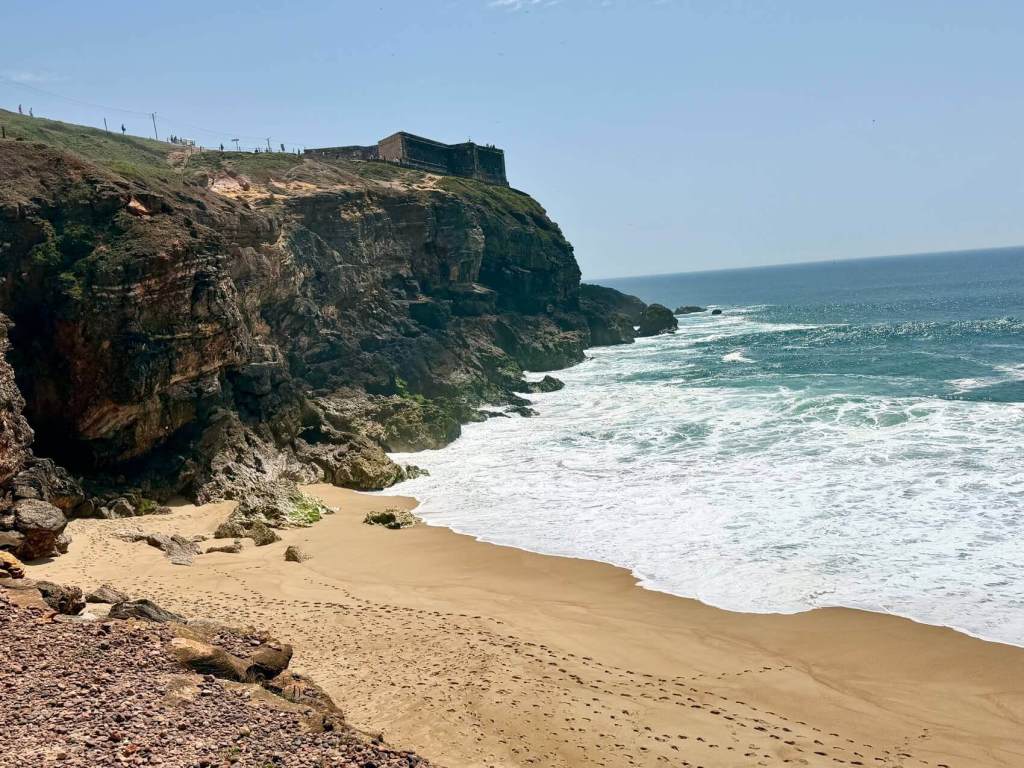
Of course, walking downhill means eventually getting back up. Visitors who do not want to make the uphill walk have another option. Tuk-tuks regularly wait near the entrance to the fort and transport passengers back up the hill. The ride costs approximately €2.50 per person.
After spending some time on Praia do Norte, we made our way back uphill. This completed our sightseeing in Nazaré and our two-day road trip from Óbidos. By then, we were ready to return to Lisbon.
Final Thoughts: Óbidos Is Just the Beginning
Our visit confirmed that Óbidos deserves more than a quick stop during a trip to Lisbon. The medieval town offers plenty to explore, but its location adds another important advantage. Spending the night allowed us to experience Óbidos both during the busy daytime and peaceful evening. Walking its nearly deserted streets after dinner became an appealing part of the visit.

However, this road trip also showed us how much there is to discover beyond the medieval walls. Within two days, we visited two magnificent UNESCO-listed monasteries and explored the unusual gardens of Buddha Eden. We also finished our journey along the dramatic Atlantic coastline in Nazaré.
Each destination offered something completely different. Batalha and Alcobaça introduced us to important chapters of Portuguese history and some extraordinary architecture. Buddha Eden added an unexpected contemporary element, while Nazaré brought us to one of Portugal’s most famous coastlines.

Óbidos remained the centerpiece of our road trip, but the nearby destinations added considerable variety to the experience. For travelers with two days available, we recommend looking beyond a simple Óbidos day trip from Lisbon. Stay overnight, explore the surrounding region, and discover how much this part of Portugal has to offer.
